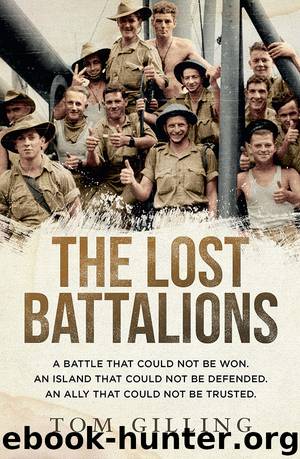
The Lost Battalions by Tom Gilling
Author:Tom Gilling
Language: eng
Format: epub
Publisher: Allen & Unwin
Published: 2018-08-31T16:00:00+00:00
Neil MacPherson also remembers the conditions being bearable in the early days at Tanyin. But things would change as work began to fall behind schedule. When he suffered a severe case of conjunctivitis, MacPherson was transferred to the base hospital at Thanbyuzayat. The doctors had very few drugs, but rations were better and being in hospital saved a patient from having to work. At mealtimes, MacPherson was pushed to the front of the rice queue along with other prisoners who had lost their sight. Shuffling around with a handkerchief over his eyes to protect them from the sun, he stayed at Thanbyuzayat for six weeks before being sent back up the line. His bed was quickly taken by someone else.
Life in the camps was dictated by the Japanese commandant, and the commandant at 35 Kilo camp was unusually humane. While his appearance was remembered as ‘grim and forbidding, especially after leaving his razor untouched for a week’, Lieutenant Yamada ran the camp with ‘intelligence and tolerance’. Unlike other commandants, and contrary to the rules of the Imperial Japanese Army, Yamada went out of his way to ensure that Colonel Williams was treated in keeping with his rank, and did not demand to be saluted himself as he moved about the camp. According to Harry Walker, Yamada ‘had been educated in England and he did not allow harsh punishment’.
Near the camp was a Burmese village. Since the camp had no fence, prisoners were able to slip out and bargain for fruit and chickens. Yamada found out and ordered the visits to stop, but when a snap parade found two dozen men missing he sent out armed guards to bring them back. ‘An hour or two later,’ the battalion history records, ‘they marched into camp under escort, shirt fronts bulging with trussed-up fowls, pomeloes and other good things’. Yamada confiscated the merchandise and had it sent to the guards’ hut. That evening he announced that the owners could retrieve their property, but it had to be done after dark, ‘as Yamada did not wish to witness the illegal act’.
Around this time, the prisoners were allowed to send a printed card home. Under the heading ‘Imperial Japanese Army’, it read,
I am still in a P.O.W. Camp near Moulmein, Burma. There are 20,000 Prisoners, being Australian, Dutch, English, and Americans. There are several camps of 2/3000 prisoners who work at settled labour daily.
We are quartered in very plain huts. The climate is good. Our life is now easier with regard to food, medicine and clothes. The Japanese Commander sincerely endeavours to treat prisoners kindly.
Officers’ salary is based on salary of Japanese Officers of the same rank and every prisoner who performs labour or duty is given wages from 25 cents (minimum) to 45 cents, according to rank and work.
Canteens are established where we can buy some extra foods and smokes. By courtesy of the Japanese Commander we conduct concerts in the camps, and a limited number go to a picture show about once per month.
Download
This site does not store any files on its server. We only index and link to content provided by other sites. Please contact the content providers to delete copyright contents if any and email us, we'll remove relevant links or contents immediately.
| Africa | Americas |
| Arctic & Antarctica | Asia |
| Australia & Oceania | Europe |
| Middle East | Russia |
| United States | World |
| Ancient Civilizations | Military |
| Historical Study & Educational Resources |
The Radium Girls by Kate Moore(12093)
100 Deadly Skills by Clint Emerson(4972)
Rise and Kill First by Ronen Bergman(4838)
The Templars by Dan Jones(4732)
The Doomsday Machine by Daniel Ellsberg(4545)
The Rape of Nanking by Iris Chang(4255)
Killing England by Bill O'Reilly(4042)
Stalin by Stephen Kotkin(4004)
Hitler in Los Angeles by Steven J. Ross(3978)
12 Strong by Doug Stanton(3575)
Hitler's Monsters by Eric Kurlander(3384)
The Code Book by Simon Singh(3250)
Blood and Sand by Alex Von Tunzelmann(3240)
Darkest Hour by Anthony McCarten(3161)
The Art of War Visualized by Jessica Hagy(3043)
Hitler's Flying Saucers: A Guide to German Flying Discs of the Second World War by Stevens Henry(2777)
Babylon's Ark by Lawrence Anthony(2718)
Tobruk by Peter Fitzsimons(2559)
The Second World Wars by Victor Davis Hanson(2554)
